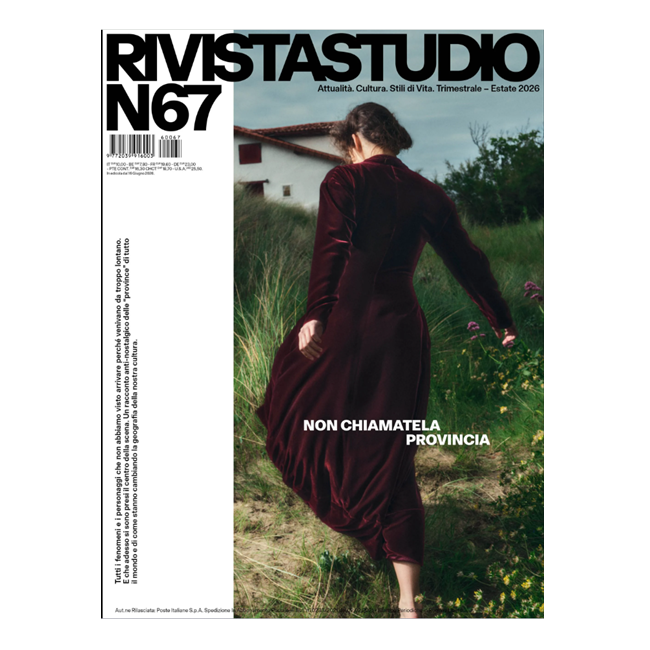
The new issue of Rivista Studio, Non chiamatela provincia (Don't Call It Province), explores phenomena and figures emerging from afar—from geographical and cultural areas usually excluded from major conversations. Yet, these very realities are the most vibrant and fascinating to discuss today. Here, we present the editorial by editor-in-chief Valentina Ardia, published inside the magazine. From the publisher: The future is not being written in the anesthetized centers of the world as we know it. It happens askew, in that off-camera space we believed for decades to be motionless, confined to the status of a periphery to history or custom. The outsiders we didn't see coming are instead right here, proving that the margin has ceased to be a place of exclusion or pure backward-looking nostalgia, becoming the true epicenter of the global imagination. Mapping this periphery is not an exercise in provincialism, but the only way to comprehend the complexity of the present. It is the decoding of an unprecedented cultural redemption that assembles, piece by piece, the mosaic of the periphery as the new center of the contemporary. "I have always thought of the province as a place par excellence from which one can look at the world, perhaps precisely because the boundaries are more blurred and reality presents itself as less codified than in large metropolises." In this reflection by Luigi Ghirri lies the methodological manifesto of the issue you hold in your hands. What remains outside the frame, the unseen, is just as important as what we show. If the limit, as philosopher Jean-Luc Nancy wrote, is not a line that separates but the space where identities meet while retaining their uniqueness, then the periphery becomes the place where the unexpected organizes itself before going global. This is the dimension of "restanza" (the choosing to stay) investigated by anthropologist Vito Teti in his essay Il senso dei luoghi (The Sense of Places): those who remain in marginal territories perform a political and cultural act capable of reshaping our roots. But this is a dynamic restanza, one that claims the right both to escape and to connect. This drive is mirrored in the analysis Kit Mackintosh wrote for Rivista Studio. A critic and pioneer of invisible musical geographies, Mackintosh traversed the locales and stories of the underground before their debut in global pop, deriving a single, sharp certainty from it: the underground will never die. Moving our gaze closer to home, this urgency tackles specific territories and geographies. Author Giulia Scomazzon emphasizes this, explaining how necessary it is to stop treating the province as an aesthetic of destruction with an inescapable destiny. Her investigation dialogues (without fearing collision) with the horizon evoked by director Francesco Sossai in his Città di pianura, where the province manifests through a precise poetics of space: back roads, fog erasing land borders, suburban walls, and isolated farmhouses. In this rarefaction, the margin ceases to be isolation and becomes a chosen space, a stronghold where reality resists banalization. This new atlas of proximity finds a perfect visual counterpart in the gaze of two artists who have given a profound social value to the theme of this issue: Alessio Bolzoni illustrates the eight central stories through a photographic portfolio that shifts his investigation of the body into a visual series made of suspended places, people, and liminal spaces, capable of disrupting the usual clichés. Meanwhile, Aitor Laspiur captures a fashion story immersed in the architecture and contrasts of the Basque province, exploring the silent, anthropological dialogue between the human being and the surrounding space. Both remind us that the province has ceased to be the antechamber to the mainstream: it is, finally, the place from which the present is being rewritten.
 English
 Italiano